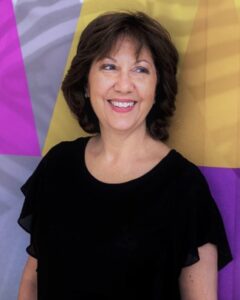
Jazz vocalist Teri Wade took on the role of cooling, soothing zephyr at Pangea recently, on an intensely hot and humid Manhattan night. Her resonant and rather deep voice was suited to the no-nonsense approach she took with her musicians, her material, and her audience. There was not a lot of high drama in her singing, yet she was clearly focused on the emotional content of the lyrics as well as her musicality. She came off as a smart, buoyant, and easygoing performer.
As with many jazz shows, the occasion had a casual quality.
Teri Wade
Wade held some between-song huddles with her musicians to figure out whatever it was that needed to be figured out: Tempo? Key? Perhaps the placement of instrumental solos within the song? Unlike some jazz folk, however, she gave the show a bit more formality by including a theme for her hourlong set—she made it a tribute to the people in her life who were influential in shaping her musical sensibilities. For instance, after her opening number—a swinging “Let’s Face the Music and Dance” (Irving Berlin)—she acknowledged that Fred Astaire and Ginger Rogers had sparked her interest in the American Songbook when she watched them on the late show when she was a kid.
Other influences she celebrated were a bit closer to home, such as the late singer Carol Fredette, with whom she personally studied. Wade credited Fredette with piquing her interest in the wit-filled songs of yet another of her influences, composer Dave Frishberg, two of whose songs she performed: a pensive “Little Did I Dream (lyric by Johnny Mandel) and a full-throated “Zanzibar,” a song that in part celebrates old-school exotica and in part seems to send it up a little.
Nearly all songs in the set were up-tempo. Wisely, in a time when some jazz-singing artists seem to incorporate scat turns on nearly every number, she kept it to a minimum. There was irony in her jazz-waltz version of “This Nearly Was Mine,” as the regret-drenched Rodgers & Hammerstein lament was turned into a peppy frolic. That sort of reversal of expectations happens all the time in jazz sets, so no problem there. I was surprised, however, by the scarcity of songs in Wade’s ballad column. I have no idea why this was so, as the one true slow-tempo song of the evening, “Smile” (Charles Chaplin, John Turner, Geoffrey Parsons), was a blue-ribbon winner, showcasing her contemplative side and demonstrating her versatility. More ballads next time, please!
As the show moved toward its conclusion, Wade gave us a jolt of energy during Duke Ellington and Don George’s “Ain’t Got Nothin’ But the Blues.” This was a definite highlight of the evening.
A first-rate corps of musicians supported Wade throughout the set. Cecilia Coleman led the way on piano. JoeWade (Teri’s husband) played bass with sensitivity and quiet fervor. Stan Killian on sax contributed something appealing on nearly every number. And drummer Scott Neumann had a particularly likable solo during Wade’s take on Irving Berlin’s “Blue Skies.”
###
Presented at Pangea, 178 2nd Avenue, NYC, July 30, 2025.
Mark Dundas Wood is an arts/entertainment journalist and dramaturg. He began writing reviews for BistroAwards.com in 2011. More recently he has contributed “Cabaret Setlist” articles about cabaret repertoire. Other reviews and articles have appeared in theaterscene.net and clydefitchreport.com, as well as in American Theatre and Back Stage. As a dramaturg, he has worked with New Professional Theatre and the New York Musical Theatre Festival. He is currently literary manager for Broad Horizons Theatre Company.