




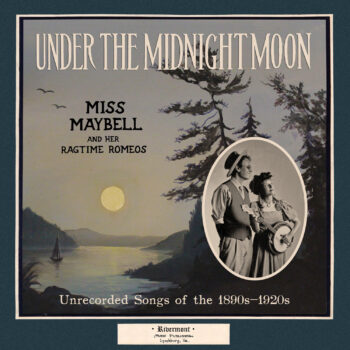
Miss Maybell and Her Ragtime Romeos — “Under the Midnight Moon—Unrecorded Songs of the 1890s – 1920s”
An amazing feat of research, re-vivification, and recording, the unique new album Under the Midnight Moon proffers tickling, period-style renditions of 15 previously unrecorded American songs dating from 1899 to 1924. Entertainingly performed by “Miss Maybell” (vocalist Lauren Sansaricq) and her “Ragtime Romeos” (pianist Charlie Judkins and a kickin’ band of banjo, accordion, brass, wind, and string players), these songs were unearthed through tireless scouring by Sansaricq and Judkins amid collections of sheet music at flea markets, housed in the Library of Congress, or handed down to relatives of the composers.
Despite its vintage material, the album makes for a highly “interactive” experience, as it draws the listener down research “rabbit holes” one minute, while propelling us to get up and dance the next. The tidbits of historical information the liner notes provide about the various musical selections are so alluring that one is inclined to spend countless hours chasing down further fascinating factoids about the composers and performers affiliated with the different songs. Some are familiar names, others totally unknown. And while hearing their music sparks curiosity to learn more about them, we also come to understand how the music business of the early 20th century was driven by the selling of sheet music, not records. Just because a song was not recorded doesn’t mean it wasn’t popular, important, and, in some cases, quite wonderful—particularly if the song, like several on this album, was written, published, and performed by artists living far away from the era’s pop-music epicenter in New York’s Tin Pan Alley.
Additionally, one is reminded of what a “dance crazy” era this was, as the album’s arrangements, all in strict time, adhere to the belief publishers had back then—that all popular music needed to be “danceable.” New social dances were being created by the minute, many based on folk traditions with animal-referencing names, and soon made more “genteel” by the likes of Vernon and Irene Castle, before then growing even wilder in the 1920s. As I listened to the album’s irresistibly rhythmic ragtime tunes, it was all I could do not to jump up and start Turkey Trotting around my apartment.
Though limited to ragtime, blues, and early jazz songs written within a tight 25-year time period, this well-curated assemblage in no way lacks variety. It launches with a terrifically bouncy rag, “Georgia Lee” (1915), written by a woman, Ruth Fernandez Such. Unfortunately the only female writer represented on the album, Such worked in the 1910s as a “demonstrator” of new sheet music, playing the piano and singing the songs for customers in department stores in New York and Boston. “Georgia Lee” is her only known composition, but I find it memorable for the marked contrast between the descending feel within its melodic phrases and its otherwise overall cheeriness. While its effusive mirth, here underlined by lively, ornamental piano interludes, has one up and bopping ragtime-fashion in no time, the second track, “Tennessee” (Hugh Norton, 1918) presents a dancer’s dilemma. Self-published by its composer, and marketed as a “rag jazz one step,” its pronounced country flavor is keenly emphasized by Sansaricq’s singing. From time to time, she “pops up” to deliver a quick high note in head voice before returning to the rich, full sound of her lower range. She lends a suitably rural, and affectionately comic quality to the song. Yet by 1918, the Castles were all the rage and had “smoothed out” the one-step into a version more reflective of ballroom than hoedown sensibilities. So how exactly to deport oneself while one-stepping to this one?
Shifting styles, into a raw, Southern blues sensibility, “The Unknown Blues” (Clarence Williams and Freddie Johnson, 1923) is deliciously sung, with more gusto than sadness, and is likely to tempt one into uncharted research territory. According to liner notes, Williams ran one of the leading African American-owned music firms in the country in the 1920s. (How many other such firms were there at that time?) Yet, despite being a prolific composer, many of his songs, like this one, were copyrighted but never published. (Why?) It was from a hand-written score Williams had deposited in the Library of Congress that Sansaricq and Judkins learned this song. And hold on history buffs, it gets even better: the solo cornet passages performed on this album, by Colin Hancock, were played using the same mutes Williams’s long-time trumpeter Ed Allen used in their recording sessions back in the 1920s.
Okay, c’mon, no more researching, back to listening. Next up is a track for theatre-music fans, “New York, I’m All for You” (Edwin Weber, 1917), popularized, at the time it was published, by the risqué vaudeville star Eva Tanguay. The vocally chameleonic Sansaricq proves expert, throughout the album, in adapting her voice to evoke the distinctive sounds, styles, and “characters” of this period music. To render this bright, pleasing anthem to New York City, she adopts a more polished, classical style of vocal production, and brings a theatrical performance quality that makes it, for this “Broadway baby,” one of the highlights of the recording.

In another smartly programmed shift, things pivot from showy to soothing, with the slow, peaceful waltz ballad “Sun Ray,” (John Miller and Axel Seaborg, 1921). In an arrangement by pioneering African-American ragtime composer-arranger Harry P. Guy, it has the choreographer in me imagining how perfectly the song’s four-note melodic fragments would fit with the era’s popular Hesitation Waltz (danced as four steps, followed by two counts of rest).
And yet another pleasing change of pace takes us into the first of the album’s two instrumentals, “Domino Rag” (Richard Glade, 1907). Self-published by its composer, in Chicago, it’s the only piece Glade wrote, and its prim, perky style will put a huge smile on your face. The other instrumental, “Saturday Night in New Orleans” (1900), also self-published by its composer, William Kinder, in Byrds Creek, Wisconsin, is marked by a more foot-stompin’ quality and an attractive little melody.
In the liner notes, it’s suggested that some of the album’s songs may have become more well-known or recorded if they’d been better promoted, or plugged as more than a newspaper “freebie,” as was the Side A closer, “Sadie, the Princess of Tenement Row” (Frederick V. Bowers and Charles Horwitz, 1903). A delightful, character tribute song, it appeared in the July 26, 1903, edition of Hearst’s Chicago American.nHere animated by fun oom-pah trombone accompaniment, it will surely send you out hunting for more such “freebies.”
Side B opens with the amusing “Do It the Right Way” (Seymour Furth and Will A. Heelan, 1910). A quick, catchy tune, it’s my album favorite, mainly because of the lyrics. It captures the perspective of a dancer, thoroughly dissatisfied with the performance of her partner, whom she instructs to “lose all those new-fangled movements,” that are making him stumble, and “do it the right way.” The song sits well in the middle of Sansaricq’s range and she sings the relatable lyrics with the perfect trying-to-be-patient tone of an exasperated traditionalist—or of anyone who has ever had to teach a less-than-promising someone to dance.
Coincidentally, I started writing this review just after finishing journalist (of TV’s 60 Minutes fame) Shana Alexander’s Happy Days: My Mother, My Father, My Sister, and Me, one of the most engrossing memoirs I’ve ever read. In the book she details much about the shockingly unusual parenting styles of her mother and her father, the composer Milton Ager (best-known for co-writing “Happy Days are Here Again,” with Jack Yellen). Thus, I was pre-disposed to be enticed down the research rabbit trail prompted by the album’s inclusion of “Non-Stop Lovin’ Man” (Milton Ager and Jack Yellen, 1923), the sheet music for which Sansaricq obtained personally from Ager’s nephew. A take-off of sorts on the period’s dance marathons fad, the song is fabulous! It has a strong, duple-time feel that really pulls you into the “movement” of the music and features “conversational” trumpet solos that teem with personality.
Completing the album proper are the romantic “Plain Country Rose” (Irving Kaufman, Jack Kaufman, and Eugene West, 1924), unmemorable except for a couple of fun clarinet and violin passages; the heavy, bluesy, howling brass-accompanied “If I Ever Get Back to Cincinnati” (Chris Smith and Sherman H. Dudley, 1906), which may lure you into researching Dudley’s establishment of America’s first Black vaudeville circuit; and the title song, written by Al Dubin and Joseph Burke, in 1913, its interestingly syncopated tune making it, perhaps, the most musically captivating piece on the album.
But wait, there are two bonus tracks, “That Hesitating Rag” (Tom E. Francis, and Will A. Francis, 1911) and “Bye-Bye My Babykins, Bye-Bye” (Will H. Penn and Gene Jefferson, 1899), both recorded in vintage fashion, as acoustic brown wax cylinder records. And to add to that period authenticity, in performing these two songs (arranged solely for voice and piano), Sansaricq and Judkins channel the performance styles of famous comediennes and musicians of the time. The historical recording process results in that scratchy, static-y, far-away quality we usually hate putting up with when listening to recordings of music of this age. But here, it’s enjoyable! And more importantly, it increases our gratitude for the rest of the album’s provision of sparklingly clear, nuanced performances that allow us to fully appreciate the artistry contained within these previously unrecorded gems.
###
“Under the Midnight Moon,” co-produced by Lauren Sansarique and Charlie Judkins on Rivermont Records. The Ragtime Romeo musicians include Charlie Judkins (piano), Gavin Rice (cornet, banjo, accordion, bass, tuba), Dan Levinson (clarinet, saxophones), Andy Stein (violin), Brian Nalepka (bass, tuba), along with special guests Mike Davis (cornet), Jim Fyer (trombone), and as already noted, Colin Hancock (cornet),

About the Author
Lisa Jo Sagolla is the author of “The Girl Who Fell Down: A Biography of Joan McCracken” and “Rock ‘n’ Roll Dances of the 1950s.” A choreographer, critic, and historian, she has written for Back Stage, American Theatre, Film Journal International, and numerous other popular publications, encyclopedias, and scholarly journals. An adjunct professor at Columbia University and Rutgers, she is currently researching a book on the influence of Pennsylvania’s Bucks County on America’s musical theatre.