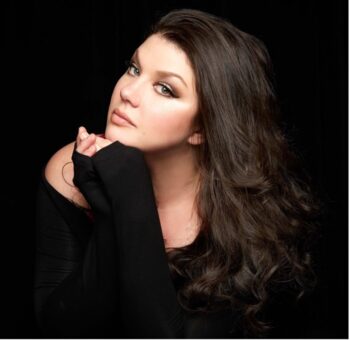
The magnificent jazz vocalist Jane Monheit brought her new 60-minute show of eleven sensuously rendered Cole Porter classics to the Upper West Side’s Smoke Jazz Club in July. While billed Jane Monheit Sings the Cole Porter Songbook, this is not one of those endeavors motivated by the digging up of obscure works by a well-known songwriter so as to introduce audiences to rarely heard “discoveries.” This show’s star is definitely Monheit, not Porter, as the singer takes the composer’s most beloved songs and uses them as launchpads for her own adventurous jazz journeys.
Jane Monheit(Photo courtesy of the singer.)
Monheit wouldn’t win any awards for diction, and it’s sometimes hard to detect when she shifts from Porter’s lyrics into her own scatting syllables. But it makes no difference, as her vocals are so deliciously emotional and musically variegated that everything contained within the familiar Porter songs is fully expressed, and then enriched, embroidered, or reconfigured.
Singing is, perhaps, the most personally exposing form of artistic expression, and Monheit reveals it all. She’s one of those vocalists who totally surrenders to her music-making, such that the notes seem to ooze from deep within her body. Costumed in an off-the-shoulders, leopard-print dress, Monheit exudes a come-hither persona that feels reminiscent of another era. She tosses her hair, sweeps her hand through it, and seduces with her intoxicating vocals.
Though Monheit’s voice seems happiest in the higher ranges, the facility with which she travels through the registers is extraordinary and, to my ear, that’s when her unique sound really emerges. In a warm, engulfing interpretation of “Easy to Love,” she tiptoes adroitly up high, then plunges ravishingly into vibrating low tones that sound like they’re emanating from an expertly bowed cello. While she spends lots of time scatting in the upper realms on “Why Can’t You Behave?,” her smooth descents to growl out the song’s alto-ranged melody beautifully emphasize the song’s graceful contours.
Only once during her show does Monheit train the spotlight squarely on Porter. She explains how jazz vocalists often sing only the first verse of a standard, let each of the instrumentalists solo, and then finish up with a repeat of the same verse. Noting how unfair that can be to tunesmiths such as Porter, who write multiple verses of witty lyrics that may go unsung, Monheit serves up an extended performance of “It’s De-Lovely,” including many more verses to that song than I (and most jazz audiences, I suspect) have ever heard.
Though she gives a mesmerizing performance of “In the Still of the Night,” and the sincerity with which she delivers the ballad “Do I Love You” is extraordinary, for me the highlight of the evening was her swinging singing of “Begin the Beguine,” its new, tailor-made arrangement by her bassist, Neal Miner, showcasing the most attractive qualities of Monheit’s vocals. Accompanying Monheit throughout, and adding immeasurably to the show’s musical excitement, is the tight trio of Miner, pianist Max Haymer (who also contributed some arrangements), and drummer Rick Montalbano (Monheit’s husband). Haymer’s racing piano solo in the opener, an ecstatic arrangement of “I am in Love,” lets us know, from the get-go, that we are in for an evening of top-flight jazz entertainment. Miner’s energizing bass gives the whole shebang a highly active rhythmic foundation, and all three shine in electrifying solos and instrumental interludes throughout.
During the largely autobiographical patter that serves as the connective tissue for Monheit’s show, we learn that in the 1990s Monheit was a student at Manhattan School of Music. Part of that “education” involved hanging out at Smoke (originally Augie’s) and learning from the jazz greats who performed there on a regular basis. As Monheit talked fondly of those times (it’s also when and where she connected with Montalbano) and described how important they were to her musical evolution, I came to appreciate the full-circle nature of what I was seeing—Monheit, now a jazz vocalist par excellence herself, “paying it forward” to future generations.
###
Presented at Smoke Jazz Club, 2751 Broadway, NYC, July 15-19, 2026.
Lisa Jo Sagolla is the author of “The Girl Who Fell Down: A Biography of Joan McCracken” and “Rock ‘n’ Roll Dances of the 1950s.” A choreographer, critic, and historian, she has written for Back Stage, American Theatre, Film Journal International, and numerous other popular publications, encyclopedias, and scholarly journals. An adjunct professor at Columbia University and Rutgers, she is currently researching a book on the influence of Pennsylvania’s Bucks County on America’s musical theatre.