




Janis Siegel Riffs on The Manhattan Transfer, the Genius of Jon Hendricks, and Her New Album, “The Art of Vocalese”
“I think that vocalese is a great addition to any aspiring jazz singer’s practice.” –Janis Siegel
In 1972, the Watergate burglars were apprehended, The Godfather came to the big screen, and I started college.
Arguably as important as any of that, 1972 was also the year that Janis Siegel began her work with The Manhattan Transfer—the close-harmonizing jazz-pop quartet that also included Tim Hauser, Laurel Massé, and Alan Paul.
Hauser had led an earlier incarnation of the group, but this new 1972 lineup popularized the smart sound and suave attitude that so many of us would find irresistible during our young adulthood. The group’s lineup would vary over the decades, but Siegel remained part of The Manhattan Transfer until its disbandment in 2023. Besides gracing the quartet with her clear, energetic vocals, she also proved herself to be a gifted arranger—for instance, with her Grammy Award–winning reimagining of the instrumental number “Birdland” in 1981.
“Birdland” is a prime example of “vocalese”—a musical form in which a vocalist or multiple vocalists sing lyrics to established musical lines, emulating the improvised sounds and patterns of instrumentalists. In the case of “Birdland,” The Manhattan Transfer vocalized the notes from the band Weather Report’s original 1977 track. Lyrics to “Birdland” were penned by Jon Hendricks, who, in the 1950s and 1960s (along with Dave Lambert and Annie Ross), had popularized vocalese. The form had been pioneered by musical artists Eddie Jefferson and King Pleasure in the 1940s. (Vocalese is often confused with scat singing, which also involves the mimicking of instrumental sounds by a singer but with the use of improvised nonsense syllables.)

Siegel maintained a successful solo career during most of the years she worked with The Manhattan Transfer. And she worked with other vocal ensembles as well. But after the quartet ended their long run, she pondered what she might do next. Sorting through her files, she discovered three vocalese lyrics that Jon Hendricks had written. That ultimately led to her most recent album, The Art of Vocalese (Origin Records), which debuted in September of this year. The recording brings to life those three Hendricks creations and also features six other fresh vocalese tracks. Siegel will sing live renditions of songs from the album at her November 4 show at Dizzy’s Jazz Club at Jazz at Lincoln Center.
I spoke with Janis over the phone in mid-October—about Jon Hendricks, vocalese, the new album, and more. What follows is a (somewhat abridged) record of our conversation.
When did you first hear about vocalese and how did you respond to it?
I learned about vocalese, really, at the very, very beginning of putting the Manhattan Transfer together, because our first record has a vocalese that Tim and I wrote together. I mean we were into this from the get-go, and I really learned about it through Tim and playing some of the standards of vocalese—you know, all the Annie Ross lyrics and Lambert, Hendricks & Ross. Learning about Eddie Jefferson and King Pleasure, and the Dave Lambert Singers. … I was always fascinated by the art form.
What was the thing that appealed to you most about it?
To me, it was a way to get inside the mind of the great improvisers. Because, when you’re … physically singing or transcribing these great solos, you’re seeing how the original soloist negotiates their way through the chord changes, and you follow their thinking and their construction of new melodies. They’re improvising. And then you are sort of honoring that, by staying close to the original notes and timbre of the soloist.
How did what Manhattan Transfer did with vocalese differ from what Lambert, Hendricks & Ross did?
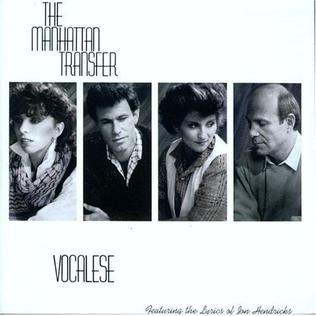
Cheryl Bentyne, Alan Paul, Janis Siegel, Tim Hauser
Very different ensembles—very, very different ones. Lambert, Hendricks & Ross was a group of soloists. And there were only three parts: two men and one woman. So, the voicings for that harmony … are very open, and they have to be totally specific and precise, because you’re outlining the chord with only three voices. You’re outlining all of Duke Ellington’s or Count Basie’s orchestra with just the essential notes. So, that’s fascinating to me.
Dave Lambert probably wrote the voicings down, although neither Annie nor Jon could read music. But Dave probably wrote it down somewhere. I’d love to find those archives.
Our group [relied more] on four-part closed harmony. And we were not, really, a vocal group of soloists. We would strive to create a blend. … I don’t think Lambert, Hendricks & Ross were concerned about a blend at all. Also, Manhattan Transfer did a ton of other stuff—other than vocalese. Lambert, Hendricks & Ross are sort of [known primarily for vocalese] because of the genius of Jon.
Listening to both Manhattan Transfer and Lambert, Hendricks & Ross, I noticed that sometimes the singers are singing in unison, and sometimes they’re singing in harmony. Do you feel that, because you had the four voices, you utilized harmony more than they did?
Yeah, oh yeah. Definitely. I mean that was our thing. Except for the odd, you know, real solo for somebody, we picked our songs according to the harmony: how much of a vocal arrangement we could construct or reharmonize. Or we would completely reinvent a tune. Our priority was the harmony.
Does it also depend on the musical number that you are “vocalese-ing”–on how much harmony is used in the original? Is that part of it?
Yes. I mean, if you’re doing a vocalese arrangement of a Big Band arrangement, like Lambert, Hendricks & Ross did a lot with the Count Basie songbook, then yes. You would harmonize the background parts. You know, you’re paying tribute, you’re honoring the original arrangement in vocalese. … It’s almost like casting a play, actually—writing a vocal arrangement for a vocalese piece. Because you’re saying, “Who would be best to express this instrument?”
When I wrote a vocal arrangement for “Blues for Pablo,” which is a fairly complex piece that Gil Evans wrote for Miles Davis, based on the blues form, I cast my [singing] partners as you would cast an actor. Who would be the best to express the sound of the French horn, the alto flute, the bass trombone? And then who would be best [to represent] the soloist? Who would be the best Miles Davis? Who would be the best Clifford Brown? Who would be the best Coleman Hawkins?
Did you sometimes have the vocalists “audition” for those roles by having them sing it, and then maybe rethink it? Or did you pretty much know who would be the right choice?
I think it would be obvious if it wasn’t working. It’s usually the arranger’s prerogative to, you know, make the initial casting call.
I listened to the interview with Lezlie Harrison that you did for WBGO, and you talked about how any musical number can be reimagined with a vocalese treatment. But would you say that the vocalese tradition grew out of bebop?

Yeah, I would. I would say that it came out of the same kind of urges that caused the swing musicians and the singers of the ‘40s to be looking for something more, to be wanting different chord changes and reharmonizations and different rhythmic patterns. When the instrumentalists … constructed bebop and that evolution happened, the whole role of the rhythm section changed. The bass had a different function. The bass was walking, you know, in bebop, basically. And the drummer had a different function. And the pianist was starting to comp [“accompany”] in a different way, and re-harmonize things.
So, the singers also got bored with just singing standards the same way every time. I think they were looking for a challenge. So, yeah, I think vocalese really began around that time—say late ’40s, ’50s.
When you are arranging vocalese, I guess you have to make a decision as to which instruments from the original will be performed by human voices and which will remain instrumental. Is that a difficult thing, or do you just sort of do it by instinct?
No, I don’t think it’s difficult. That’s just in the realm of arranging. You make decisions like that.
Over the course of The Manhattan Transfer career, was there a sort of ebb and flow in terms of how much you worked with vocalese?
Well, you know, we did do an entire album [in 1985], devoted to vocalese—called Vocalese! At that time we were concentrating just on that. But in almost every single show we’ve ever done, we’ve done a fair amount of vocalese.
You’ve written lyrics for vocalese. I wanted to talk with you about that. How do you decide, for instance, how much rhyming you want to include? I notice that, in some songs, there’s a lot of internal rhyming and complex rhyming, and in others it’s not so important. Is that also something you do by instinct?
It’s an interesting question. I think it’s the same process as if you were writing any kind of lyric. You decide what the rhythmic scheme is gonna be and what the rhyming scheme is gonna be … at the get-go, and then you sort of have to keep to that pattern.
In the Michael Brecker solo [“In the Presence and Absence of Each Other”] that I lyricized, for instance, on the new record, it was more of an internal dialogue. So I was very free with my rhyming sequence. Some things rhyme, and then some things just go on like I’m talking to myself. I wouldn’t necessarily be rhyming everything.
When you talked with Lezlie Harrison, you talked about how you would start sometimes with the title of the original composition to give you a cue as what to write about. Then, do you sort of plan out exactly what needs to be said, or do you just start writing and see where it goes?
I learned that from Jon—to use the title as a jumping-off point. If it’s possible. Sometimes, the titles are so abstract and really don’t feel like they have anything to do with the music. So, then I would change the whole thing. But with something like “The Sidewinder” or “Sing Joy Spring,” Jon takes those words and builds a whole universe around them. … Usually, what I do is start where I feel I have the most energy—where I’m most certain of what I want to do, And, yeah, I do think about the arc of the song. But sometimes I just let it flow and see where the song wants to go. … It’s different every time, I think. I think the music tells you what it wants you to say, in a way.
Was writing lyrics something that just sort of came naturally to you or was it something that you had to practice a lot before you really ran with it?
Well, I wrote songs as a kid, as a teenager, you know, I. wrote a lot. It was a regular part of my life. And then, when I joined the Transfer, I stopped for a while because there were so many great songs that I got intimidated. We were [singing] the best of the best, cream of the crop. But then, gradually, I got back into it. I’m not a prolific writer by any means. But sometimes I just get madly inspired, and then it comes fairly quickly. And I’m always trying to learn, you know, from people that really identify as songwriters and have certain tricks. There are little tricks and little tips that you can pick up along the way. But with vocalese, it’s a lot of listening, to hear what the music is telling you.
I know that you worked with and became a good friend with Jon Hendricks, and I remember when we gave him the Lifetime Achievement Bistro Award and you were there, and it was such a wonderful night. Can you talk a little bit about working with him and your relationship with him?
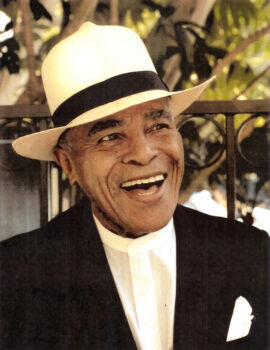
I guess our relationship really began when we did [the song] “Birdland,” which was about 1980. Cheryl [Bentyne] had just joined the group. And we had commissioned Eddie Jefferson to write the lyrics to the song “Birdland”. … We were all in Los Angeles at that time. … And we were hanging with Eddie Jefferson and Richard Cole and Tom Waits. And then it came time to go into the studio, and I needed the lyrics to write the vocal arrangement.
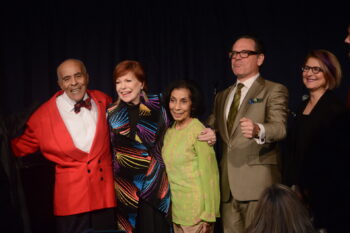
Janis Siegel at the 2017 Bistro Awards.
And Eddie was murdered. Eddie Jefferson was tragically murdered outside a club in Detroit. …It was a terrible tragedy.
And he had never started the lyrics. After a reasonable amount of time we asked his widow if there were any papers or anything that indicated whether he had started, and he hadn’t. … So we immediately called Jon Hendricks, and that was really the beginning of our very close relationship with him. We had been doing Jon Hendricks songs since the very beginning of the group. We did “Doodlin’.” We did “I Want You to Be My Baby,” which was a pop tune that he wrote.
But then, [after “Birdland”], we really became close, and I think Jon maybe was living in northern California at the time. So we saw him a lot. … Then I was his neighbor here in New York. And I spent a lot of time with him and his wife, Judith. And both daughters, actually: Aria and Michelle. He lived walking distance from my house, and I would bring my son down there, and we’d hang out. And he’d come up here for dinner a lot. And then he’d come over, and he’d write. …
When we did the Vocalese record, we got really intense with Jon because he came on the road with us and critiqued us. And we had to really prepare for that record. We couldn’t just learn the charts the night before and go in [to record]. … So, it was like a master class every night.
Did you talk a lot about the music, or did you mostly absorb what you learned from him by working with him and listening to his work?
It was mostly being with him, yes, listening to him sing, watching him write. And just, you know, being with him: walking with him, eating with him, going places with him. The last time I worked with him one-on-one was when we did our version of “The Sidewinder,” Lee Morgan’s great piece. Actually it was not for our album It was our keyboardist Yaron Gershovsky’s record, and he cut the track. Jon wrote the lyrics to the Lee Morgan solo, and the whole story of “The Sidewinder.” And he came over and [we worked] together. This is one of my favorite things to do ever, ever in the world: to sit with Jon and parse these lyrics that he wrote. Because sometimes he didn’t know, or he didn’t remember, how they fit. So we’d go over it and over it, and then we’d realize: Oh, this needs an extra syllable or That’s too many. And we would tweak it and finish it together. And then I could write the vocal arrangement.
When you are writing the vocalese lyrics and you have a song kind of up on its feet and you’re hearing it, is there a lot of editing that goes on then? Do you change things and do that kind of parsing that you were just talking about with your own work?
All the time, all the time. Because, in the long run, [the lyrics] have to sing well. And sometimes something is just a little bit too awkward, and you change it. And as a writer, you have the prerogative, I think, to always edit your own work.
I’m wondering about how technology has changed the kind of work that vocalese singers and writers do. When you’re recording something and layering in, is that something that is a lot easier these days?
I don’t think technology has changed anything, no. I mean, it’s certainly easier to make a vocal demo these days. You can do it at home. You could do it in your bedroom. All you need is a laptop and a good microphone and an interface. For writing in general, you could make a nice demo. But I don’t think it really has anything to do with vocalese particularly. I mean, if you wanted to really fool around and cheat, … you could sync up the original solo to your track and then sing to that. But I don’t know what good that would do. (laughs)
So, I know that this album was one that you began creating soon after Manhattan Transfer ended. I know you’ve said that going through your files and finding things helped you round up the material. Before that, did you have an inkling that that might be something you would want to do?
No, actually. Really, I didn’t. I didn’t know what I wanted to do next. But finding the few lyrics of Jon’s in the house really sparked a fire. It started me thinking about doing this. Not only as a tribute to the jazz legacy of the Manhattan Transfer, … but as a tribute to Jon Hendricks, I keep talking to his daughters about this: They should put out a book of his lyrics to be read, because I think a lot of them go by so fast you cannot tell the brilliance of them. But I know that they’re brilliant from singing them and doing them 50 percent slower at first, you know, and really understanding what he’s writing about.
Did he give you those lyrics?
Yes. He left them here. He gave them to me. They were buried in some papers. He would always say, “Hey I wrote a lyric to this tune. Do you wanna check it out?” You know? As any writer would be pushing their own work.
He sang on my first solo record, actually—for Atlantic…. We were close then. That was ’81, so we were getting tight then.
Were there a lot of things that you found in the files that were promising but that you didn’t include?
I did find some other lyrics of his–yeah. To a Gigi Gryce tune, I think. But once I’d found three [songs for the album], I started remembering I had some other things, from my girl group Jalala, which is myself, Laurel Massé, and Lauren Kinhan. I did an arrangement of “It’s Sand, Man” [music by Edward A. Lewis], which has a lyric by Jon and Dave Lambert. … I thought about the larger scope of vocalese. During the pandemic, I [had written] an interpretation of Errol Garner’s [version of] “Stompin’ at the Savoy.”
I had enough for an album. But…maybe The Art of Vocalese, part 2? Who knows? And then I will take a deeper dive into cleaning my house and finding more treasures.
Do you wanna say something about your other collaborators, the musicians and other singers that participated on the album?
Yeah, the special guests [include] Jalala. You know, I have a very soft spot for a female trio because that’s how I started: singing three-part harmony like the Boswell Sisters. You know, every girl group, really, has a debt to pay to the Boswells. They were the archetype, I think, for every girl group that happened after them—from the Dixie Chicks to the Supremes to the King Sisters to the Andrews Sisters. I love that configuration of three female voices.
Lauren and I do a lot of work together, and we have a very similar sensibility. We were both altos in our respective vocal groups. And I love singing with Laurel. So the three of us together had a really beautiful blend. I’m thrilled that Laurel is gonna be able to join me on November 4th at Dizzy’s, and I’m distraught that Lauren cannot join me because she’s gonna be on the road with her group, New York Voices. They’re doing their victory lap for their last year. They’re retiring as well. But I have an idea. I’m still gonna do the Jalala stuff but in a slightly different way. So, you’ll have to come and hear that.
And John DiMartino [pianist and arranger]—you worked with him on this album, and I know you’ve worked with him a lot.
I really love working with John. I met him on a jazz cruise, actually. … He was performing with Houston Person, I think, and I had my own group. I had a trio that I put together. But John was at the jam session one night. And I got to sing with him, and, you know, there’s something that clicks for me when I hear, an instrumentalist that I can really vibe with. It’s very special, you know. Like my relationship with Fred Hersch, for instance. Duo partners are hard to come by. And I thought: Oh, I’d like to work more with this guy John. And so, yeah, that was the beginning of our relationship, and we’ve done a lot of things together, including a Yiddish record and a country jazz record.
Can you talk about the reception you’ve had for the new album so far?
I haven’t really gone out and toured it yet, but that’s coming up in November, and Dizzy’s is really kicking it off.
I’m so looking forward to doing this stuff live, and at Dizzy’s in particular. I’m just gonna go all out and try to get the same configuration that I have on the record. It’s gonna be a beautiful collection of instrumentalists and singers. And I’m going to do some other stuff as well.
So do you anticipate that that will take a lot of adjustments, performing it live?
Some of it will… But, I mean, I do a lot of vocalese. I can always augment with other vocalese that isn’t on the record. But my hope is to do as much of the record as possible. And, certainly, that will happen on November 4th.
Anything else you would want to say about the album, about vocalese, about Jon Hendricks, or about anything else?
The only thing I’d like to say is that I feel that vocalese is a great “gateway drug” for anyone who wants to sing jazz. For the very reason I mentioned before: You get into the mind of the great improvisers. And part of learning something, initially, is copying it. In the world of jazz, for instance, a lot of singers get up on their own two feet by imitating Sarah Vaughan, by imitating Carmen McRae, by imitating or being inspired by Betty Carter, for instance. And then you find your own voice through that imitation.
I think that vocalese is a great addition to any aspiring jazz singer’s practice.
# # #

About the Author
Mark Dundas Wood is an arts and entertainment journalist and dramaturg. He began writing for BistroAwards.com in 2011 and was an associate producer of the awards show beginning in 2022. His reviews and articles have also appeared in such publications as American Theatre, Back Stage, TalkinBroadway.com, and—most recently—The Village Star-Revue. As a dramaturg, he has worked with New Professional Theatre and the New York Musical Theatre Festival. He is currently literary manager for Broad Horizons Theatre Company. In 2026, his lyric for “Too Much Love” (music by Tracy Stark) received a MAC Award for Comedy/Novelty Song.