




New Book Explores the Life and Career of Maury Yeston — How Does It Touch on Cabaret?
In 2024, writer Joshua Rosenblum gave us Closer Than Ever, a study of the lives and songs of Bistro Award Lifetime Achievement honorees Richard Maltby, Jr. and David Shire. Now, he’s back, with a similar book on another man of musical theatre. A Very Unusual Way: Maury Yeston and His Singular Path to Broadway and Beyond (State University of New York, 2026) explores the artistry of the man who wrote music and lyrics for the Broadway musicals Nine and Titanic, among many other credits.
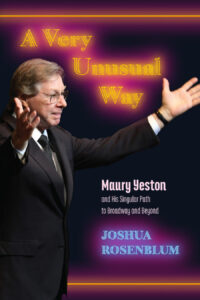
Rosenblum knows his subject extremely well. Maury Yeston was his professor at Yale back in the 1980s. And the author has done other deep digging, interviewing not only Yeston’s colleagues and other acquaintances but also the man himself.
As with the Maltby & Shire book, Rosenblum here provides descriptions of the technical aspects of Yeston’s music. There are a number of notes-on-staff illustrations showing what’s going on mechanically at particular moments within a song or other musical work. Obviously, these illustrations will connect more fully with readers who have studied music theory in some depth, although the author strives to make his explanations clear to those with little or no formal musical training. (He took a similar tack in the Maltby & Shire book.)
Strangely, though, there is very little emphasis in this book on what makes Yeston’s lyrics tick. That’s especially odd because, in an appendix (Yeston’s “Advice to Young Theater Composers”), one of the composer’s big credos is “Words First.”
Yeston is one of those musical-theater composers who’s harbored an interest in the higher tiers of classical composition. (I’m thinking of Sir Arthur Sullivan’s grand opera, Ivanhoe, or Richard Rodgers’s symphonic score for the documentary film Victory at Sea.) Yeston, though, hasn’t just dabbled. He began writing what’s sometimes called “serious music” as a child. His personal hero at age 9 was Beethoven, and his doctoral dissertation at Yale, The Stratification of Musical Rhythm, became a highly respected academic study. Throughout his career, the creation of classical works has been at least as important to him as his musical-theater endeavors. And these two sides of his career have frequently overlapped or converged.
In fact, Yeston’s musical horizons are exceedingly broad. Did you know that he had a hand in Christmas in the Stars, a disco-era pop album with a Star Wars theme? He reportedly even sang (with auto-tuning) for this recording.
Life Lessons for a Child
So, you may ask, what are Yeston’s connections to the world of cabaret?
For one thing, he gave our little niche in the musical world one especially marvelous song: the emotionally stirring “New Words,” which was written as part of an assignment when Yeston participated as a student in the famed BMI Workshop created by Lehman Engel. (After Engel’s passing in 1982, Yeston took over, leading the Workshop for two decades.)
Can anyone listen to “New Words” without their eyes welling with tears? I can’t. In the song, a parent tells a young child what some unfamiliar things in the world are named. As Rosembaum explains, Lehman Engel praised the song very highly when it was presented for the first time. Later, so did Stephen Sondheim, who wrote to Yeston, saying, “No song I’ve ever heard has pierced my heart the way this one does.”
(I tell you: It will get you every time!)
Among the singers who’ve recorded “New Words” are such familiar cabaret names as Liz Callaway, Andrea Marcovicci, D.C. Anderson, Susannah Mars, and Stacy Sullivan. I first heard it sung by Mars (and the lyrics happen to include her surname!), so I’ve shared that version above.
Other Yeston songs, such as “Unusual Way” from Nine, are heard with some frequency in cabaret clubs, but many of Yeston’s compositions for theatre are deeply bound into the musicals in which they first appeared, so much so that they don’t work especially well out of context.
This is, maybe, most true of musical selections from Titanic. According to Rosenblum, when a Gerard Alessandrini–directed revue featuring Yeston’s songs—called Anything Can Happen in the Theater: The Musical World of Maury Yeston—was staged at the York Theatre in 2019, only one Titanic song (“Godspeed, Titanic”) was included. And it was not heard on the show’s cast album.
Art Songs That Aren’t Too Artsy
Apart from “New Words,” perhaps the biggest contribution by Yeston to the cabaret realm has been a song cycle for voice and piano, first performed by Andrea Marcovicci. December Songs debuted in the Weill Recital Hall at Carnegie Hall in 1991.
Rosenbaum interviewed Marcovicci for his book, as well as her friend Karen Akers, another familiar cabaret presence, who had appeared as the protagonist’s wife in the initial run of Nine on Broadway.
Quoted at length, Marcovicci provides insight into the creation of December Songs, which—although it has a contemporary Central Park setting—was inspired by (and largely patterned after) Franz Schubert’s 1827 art-song cycle Winterreise. Says Marcovicci of Yeston:
He’s a real singer’s writer and when we got together at his house, we went over scales and he checked out exactly where my break was, where my voice was most powerful. I think he was actually capable as few composers are of writing right to the throat.
If you don’t know December Songs (as I had not), I urge you to have a listen.
Cabaret as we know it has a collection of different sorts of forebears, including performances in European watering holes and in American vaudeville shows. But I believe that, when tracking cabaret’s pedigree, the intimate private salons from centuries past, at which classical singers presented elegant art songs and song cycles, tend to get overlooked. What makes Yeston’s December Songs especially scrumptious is that the selections incorporate both the classical and the poppy sides of the composer’s musical identity. But these songs are not snooty or out of the reach of most human ears.
Take, for instance, the irresistible “I Had a Dream About You.” Intricate and exuberant, it will grab you as adamantly as “New Words” will grab you, though it’s a much different sort of song. (Listen to Marcovicci perform it here.)
Marcovicci later brought December Songs to the Carnegie Hall mainstage with a small ensemble rather than with piano only (as she’d done in the Weiss space). Other vocalists have sung and/or recorded the cycle, including singer/actor Victoria Clark, who performed it with an even larger instrumental backing.
Rosenblum also interviewed Clark, who marveled at the way “I Had a Dream About You” lends itself to both classical and pop interpretations, both of which are in her particular wheelhouse. She said that she was instructed by her musical team to go either way with the songs in the cycle—choosing whichever option seemed most “honest or right.” And that’s what she did. It’s a measure of Yeston’s elasticity that these songs encourage such divergent approaches.
Again, listen to the whole December Songs cycle if you’re in the mood for a sweet little musical revelation. (I found the Marcovicci version on Amazon Music.)
You’ll be glad you did!
###

About the Author
Mark Dundas Wood is an arts/entertainment journalist and dramaturg. He began writing reviews for BistroAwards.com in 2011. More recently he has contributed “Cabaret Setlist” articles about cabaret repertoire. Other reviews and articles have appeared in theaterscene.net and clydefitchreport.com, as well as in American Theatre and Back Stage. As a dramaturg, he has worked with New Professional Theatre and the New York Musical Theatre Festival. He is currently literary manager for Broad Horizons Theatre Company.