




Let’s Celebrate the Songbook Like We Used To
Sapped by the heat and pooped at the end of a busy week, I settled in for a quiet evening on Independence Day. Surely something on Netflix would strike my fancy on this patriotic holiday—something that didn’t involve fireworks and/or a speech by the current POTUS.
I was all set to watch a true-crime program: the dissection of a grisly murder case. But reading the description for it made me change course. What a sordid thing to watch on America’s 250th birthday—even though, considering the state of the nation at the moment, “sordid and grisly” didn’t seem all that inappropriate. In any case, I moved on.
Somehow, I wound up exiting Netflix and plopping onto a YouTube landing page, where I found a video I’d skipped over earlier but decided to check out now. This was a special episode of The Merv Griffin Show: a tribute to composer Jule Styne. Later I learned that the program first aired on May 25, 1979.
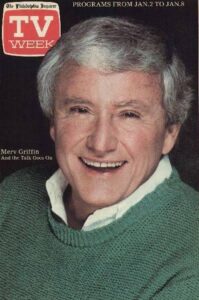
I might have seen this show back in the day, but I doubt it. I found it absolutely riveting. Surely, I would have remembered it even over the course of several decades.
For a while during the pandemic years, Netflix featured a whole collection of classic Griffin programs, including episodes with guests ranging from a disarming Jack Benny to a young and buttoned-down Richard Pryor to Mariska Hargitay as a child (appearing with her mother, Jayne Mansfield, and other family members). Unfortunately, those old shows are not still available on Netflix. Perhaps they’ll be back on the platform at a later date.
The Styne-tribute episode was so wonderful that one viewing proved not enough.
First things first, I was reminded while watching the show of something I’ve been saying for years… that if Hollywood ever needs someone to play the younger Merv Griffin, they should turn to cabaret singer Nicolas King. He would be, absolutely, the right choice.
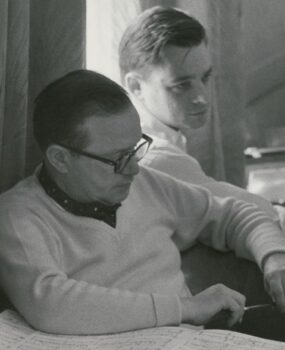
In this special episode, Griffin was in New York City, although his regular show was recorded in California at that point in its run. Episodes then were 90 minutes long, counting commercial breaks (commercials were deleted from this YouTube video).
The show opens with Griffin introducing Sammy Davis Jr., but then, a big chunk of footage seems to be missing. All of a sudden, we’re with Griffin and Davis in mid-chat, and then, shortly afterward, the man of the hour is brought to the stage.
What a rare treat to see Styne in action. I had no idea how charming a guy he was: a good-humored, self-deprecating raconteur who knows just what to include in (and what to exclude from) a well-told anecdote. In his first moments on camera, he tells a doozy—about playing piano for a performance of Gershwin’s Rhapsody in Blue with Al Capone conducting!) Then, at the piano, he plays and sings a comedic song he wrote as a teenager, followed by a piano solo of his Oscar-winning “Three Coins in the Fountain” (lyric by Sammy Cahn). Telling of his early dreams of being a concert pianist, he briefly lets us sample his talents as a “classically trained” musician. Then, in the show’s most moving moments, he plays “People” from Funny Girl. I may well have heard this song a thousand times, but hearing it and seeing it played, stirringly, by the man who wrote it, proved affecting. (Handkerchief, please. Thanks.)
Next, Styne plays as Davis sings a rich, contoured “I Fall in Love Too Easily” (also a Sammy Cahn lyric). Then Merv and Sammy duet on “Guess I’ll Hang My Tears Out to Dry” (Cahn, for the trifecta). Though he gained fame early on as a singer, Griffin can’t match Davis’s vocal prowess here, but the two nonetheless sail along together on the song…until its last two notes, which, unfortunately, crash on the rocks.
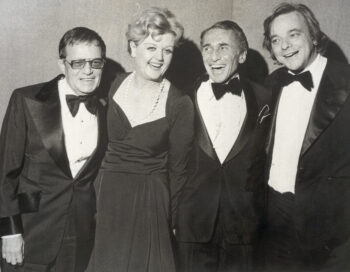
But no worries. I found the missteps in this show to be as fascinating as the highlights. I mean, why would Ethel Merman (the next guest, after Davis leaves for another gig, on Long Island) interrupt her version of Styne and Stephen Sondheim’s “Some People” from Gypsy with a few awkwardly interpolated measures from Funny Girl’s “People” (lyric by Bob Merrill), which we’d already just heard Styne play? On the bright side, Merman is in a jovial mood, and she concludes “Some People” with a brilliance that will make younger audiences and singers who know little to nothing about her comprehend why, exactly, people used to make such a fuss over the Merm.
Just having Davis and Merman on hand to salute Styne would have made for more than enough musical goodies. But additional deliciousness lies ahead in this video, including:
- Young Marvin Hamlisch, whose musical They’re Playing Our Song was on Broadway at the time, giving us a piano-only version of the Gypsy overture. (Hamlisch had been rehearsal pianist for Funny Girl).
- Betty Comden singing a snappy “If You Hadn’t but You Did” from Two on the Aisle (lyric by Comden and Adolph Green).
- Green hamming it up as Captain Hook from Peter Pan.
- Phyllis Newman, reprising the frenetic Subways Are for Sleeping number “I Was a Shoo-in”—and making me understand how she managed to nab the Tony Award that might otherwise have gone to Barbra Streisand for I Can Get it for You Wholesale.
It’s fascinating to watch these stars—all no longer with us— interact with one another. At one point, Comden, in “roast” mode, teases Styne about his tendency to ramble while talking. Styne seems to take it personally. Then, Comden (with support from Green) pivots quickly into “forget I said-it” mode. Also, it’s interesting that Griffin’s studio audience in 1979 was so calm and polite: applauding vigorously but not hooting or whistling or breaking into applause whenever somebody says something they agree with or when someone drops a name like “Sinatra.”
The inclusion of Hamlisch on this show made me recall the Bistro Awards gala in 2012 in which he was a special guest pianist for honoree Melissa Manchester. He passed away just months later. Conduit-like, Hamlish brought together, in my mind, two New York Cities: the one from 1979 that I didn’t really experience and the city I live in now.
Wonderful things happen in cabaret today. But cherishing the American Songbook the way it was cherished by participants and audience members on this vintage Griffin program is something that relatively few New Yorkers (let alone Americans) arrive at these days. I’m glad Merv Griffin celebrated this music in 1979, and I wish people like Jimmy Fallon and Seth Meyers (who needs to get his band back!) would consider occasionally featuring the best of our cabaret performers, in much the same way they feature New York stage actors—giving us the chance to text one another with the exciting message: They’re playing our songs!
Share the experience! Watch the show here: https://www.youtube.com/watch?v=X59JATcOLR
###
Photo credits: 1. Griffin on the cover of TV Week; 2. Styne with Stephen Sondheim (The NY Public Library Digital Collections, 1959); 3) Styne with Angela Lansbury, Arthur Laurents, and Stephen Sondheim (UMKC’s University Libraries Digital Project ,1961)

About the Author
Mark Dundas Wood is an arts/entertainment journalist and dramaturg. He began writing reviews for BistroAwards.com in 2011. More recently he has contributed “Cabaret Setlist” articles about cabaret repertoire. Other reviews and articles have appeared in theaterscene.net and clydefitchreport.com, as well as in American Theatre and Back Stage. As a dramaturg, he has worked with New Professional Theatre and the New York Musical Theatre Festival. He is currently literary manager for Broad Horizons Theatre Company.