




Creating a First-Rate Song List: The Importance of Your Musical Menu
Fashioning a suitable song list is an essential task for a vocalist who’s presenting an afternoon or evening of cabaret music. A thoughtfully and carefully prepared roster of the musical numbers you’ll be performing helps critics write about you with accuracy. And it signals that you are serious about your work—that you’re a pro.
In April of this year, singer-producer-educator Sue Matsuki, along with sound-and-lights tech director and singer Kelly Wohlford, hosted a panel discussion on the “Business of Cabaret” at Don’t Tell Mama. Joining Sue and Kelly as panelists were performer and booking manager Sidney Myer, publicist and singer Kati Neiheisel and I. Sue asked me to present information on what makes for a good song list. My BistroAwards.com editor, Bistro Awards producer Sherry Eaker, suggested that I might later want to share my thoughts on song lists for this website’s readership. The article that follows is a summary of what I presented on the panel.
The most essential function of your song list—and the most traditional one—is to outline the sequence of your show for reviewers and other members of the press who will come to hear you sing. In recent years, however, performers have increasingly provided copies of the list to all members of their audience. While critics are customarily given a copy of the list before the show begins (often as part of a press packet that also includes your press release and your promotional postcard), performers tend to distribute the list to general audience members at a show’s conclusion. That makes sense. You’ll want to preserve an element of surprise for your listeners about what will happen during your performance. And you won’t want them burying their noses in the song sheet during the show. You’ll want them to be looking at—as well as listening to—you!
In my decade-and-a-half as a cabaret reviewer for BistroAwards.com, I saw a variety of song lists, running the gamut from perfunctory, last-minute dash-offs to super-duper extravagant, chock-full-of-detail lists that provided show-goers with much more than the bare essentials.
Sometimes when I would arrive at a showroom, there would be no song list at all, and—on being asked—the performer would scramble to find a copy of the tech director’s sound-and-lights cues (which at least gave me the song titles in order, but essentially did nothing else). On other occasions, the singer would hastily create a handwritten roster of the songs about to be sung. (More frequently than not, the absence of a song list happened at jazz shows. More about that later.)
Essential info for your song list
A song list is workable if it gives reviewers the essential facts about the numbers being performed. An adequate song list should include a heading section with general information about your show, followed by a list of all stand-alone songs, mashups, and medleys, noting the composer(s) and lyricist(s) for each title.
The overview should begin with your name and the title of your show (if there is a title). Most first-rate song lists also include the name of the club where the show is being performed, the dates and times the show will play, the names of the director and music director (if any), and the names of all musicians, noting the instrument(s) they will be playing. It will also mention any guest singers or other entertainers who will appear in the show. (Note: There are variations on where you might place some of this info. In Natasha Castillo’s model song list below, she puts the info about time and place of performance at the bottom of the song list, rather than in the header. That’s perfectly fine.)
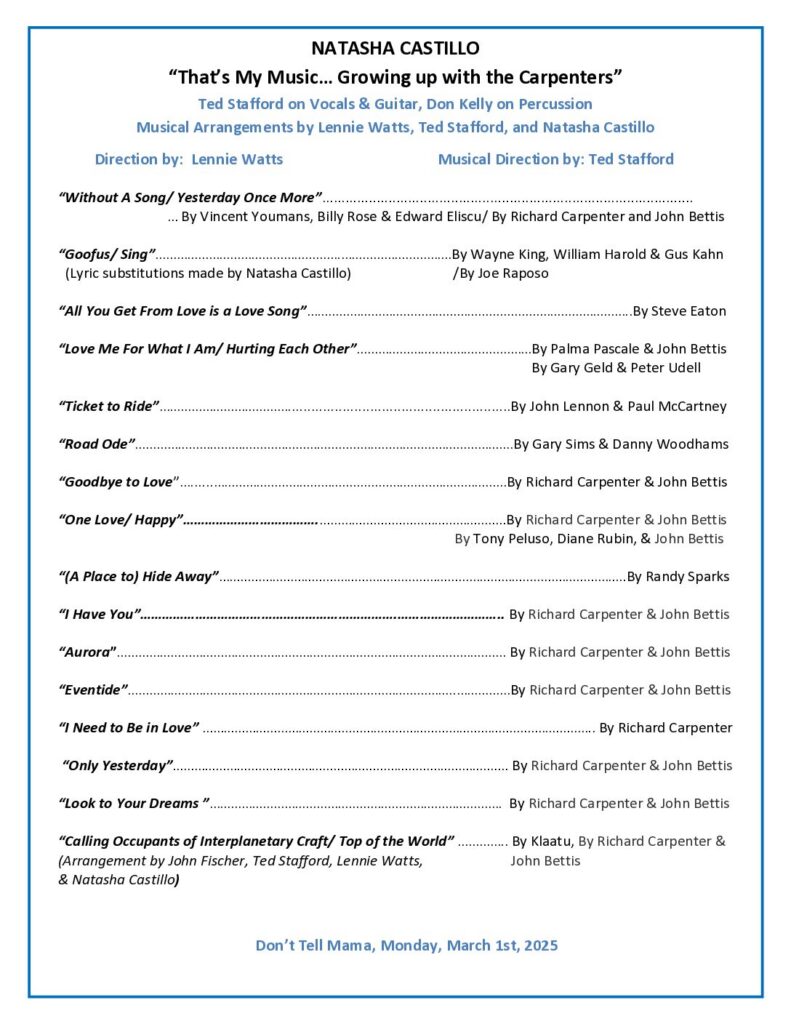
The list itself should obviously start with each song’s title, with songs listed in order of presentation. Treat any mashup or medley in your show as one entry.
You may think you know a song’s title for certain, but don’t assume anything. It’s properly “Over the Rainbow,” for instance, not “Somewhere Over the Rainbow.” In order to be accurate, double-check titles and authorship of songs at such websites as secondhandsongs.com or jazzstandards.com, or look online to Google Images for a shot of the packaging or label from the song’s original recording. Even if you are 99 percent certain, it’s worth double-checking and consulting multiple sources if you have any doubts about the title. (I wish I had a dollar for every time I’ve checked to assure myself that it’s “The Ladies Who Lunch” and not “The Ladies That Lunch.” On the other hand, it’s “The Man That Got Away”)
Following each title (often in parentheses) are the names of the composer(s) and lyricist(s). If you’re presenting a tribute show that features material from a single composer or lyricist, include only the names of that songwriter’s collaborator(s). The one thing I might suggest for making Natasha Castillo’s excellent song list even better would be to specify which of the credited songwriters she names wrote the music and which wrote the lyrics. (Ed. Note: When noting song titles in all reviews on BistroAwards.com, the composer’s name comes first, followed by the lyricist’s name.)
Sometimes you may find songs with a ridiculous number of collaborators, such as when a whole rock group is credited with a song’s creation, when producers take songwriting credit, or when the “sampling” of other songs is part of the original recorded track. The Beyoncé song “Alien Superstar” reportedly has 24 (!) songwriters listed, although many of these contributors are credited for song fragments that have been interpolated into the main song’s arrangement. In such cases, abridge the entry by listing the first three or four credits followed by “et al.”
If a song features non-English lyrics as well as English translations or adaptations, include the song’s non-English title as well as the name of the lyricist for each language. It’s customary to include the name of the writer who wrote the original non-English lyric, even if you sing only the words of the English-language version.
Many websites online can steer you wrong about a song’s authorship. Some websites that present a song’s lyrics not only get those lyrics wrong, but they also attribute the authorship to the performer who made it famous. Just for the record: Frank Sinatra did not write “New York, New York”! (John Kander and Fred Ebb did.)
For any song in your show that originally appeared in a stage musical or film score, include mention of that production’s title (italicized). But you need only include the name of the original show in which the song appeared. 1928’s “Makin’ Whoopee” gained new notoriety when it was sung by Michelle Pfeiffer in the film The Fabulous Baker Boys (1989), but the credit for the song’s origin should be the stage musical Whoopee! in which the song was introduced by Eddie Cantor.
Nonessential (but helpful) information
If, for some reason, you want audiences to be reminded of Michelle Pfeiffer’s version of “Makin’ Whoopee,” you could include that info in an annotated song list. These have become quite popular recently. (Kati Neiheisel constructs amazing ones.) They include extensive notes for each song about such things as the year of its creation, and/or its first performance or first recording; its subsequent performance history; the awards it may have won; fun facts about the songwriter(s); and even your own, personal history with the song. All of this can make for a nice keepsake if you are distributing the song list to your audience as well as to members of the press. But, again, none of this is absolutely necessary.
Some cabaret singers include biographical information about themselves, their musicians, and guest performers as part of the song list, but I believe it’s better to include bios as a separate component in your press-packet folder, perhaps as part of the press release.
Some song lists will credit the arrangers of songs in a vocalist’s show. Generally, if no arrangers are cited, readers will likely assume the arrangements were created by your musical director. If you use arrangements that others have created, it’s a polite practice to mention them on the song list.
If you’re creating the song list specifically for the press, you may consider providing several lines of blank space below each song title for reviewers to take notes about the selections. Some reviewers appreciate this. Personally speaking, I’m not a fan. Having been taught to color within the lines, I found the practice unworkable. In the darkness of the showroom, I could never find the appropriate blank spaces and didn’t want to spill ink all over the printed parts or, worse, bring in a distracting flashlight to see where I should jot my notes. Instead, I used a small and unobtrusive notepad, keeping my fingers (figuratively) crossed that I would be able to decipher my chicken scratches when it came time to write the review.
That said, I had no problem with the inclusion of those blank spaces—I just ignored them. If you do include them, remember that it will mean your song list could be several pages long. When not including the spaces, you may be able to fit the entire list on one side of a single sheet of paper, as Natasha Castillo managed to do for her Carpenters tribute show list.
Last-minute changes
Sometimes, you’ll find that, although everything on your song list is in order a day or two before your show, alterations must be made at the eleventh hour. Your pregnant drummer may go into labor on the morning of your show, creating a desperate search for a substitute. Your guest performer may decide he absolutely has to sing “Never Never Land” instead of “The Girl from Ipanema.”
This is why it’s wise not to photocopy your list too soon before the show date. You should update the song list and print out new copies, as necessary, to accommodate changes. If it’s truly a down-to-the-last-minute alteration, it’s acceptable to hand-write the change on each copy for press people and to mention the change verbally during your show to let the rest of the audience know.
While composing your review, the critic may have questions for you. This sometimes happened with me. Occasionally, I would find it unclear to whom I should turn for answers. If you have a publicist, you can provide their contact info on the song sheet. If not, you can ask someone else on your team (your director, perhaps) to be listed as the person fielding press inquiries.
If it’s necessary for you to interact personally with the reviewer, I advise against your having voice-to-voice contact with them, even if the reviewer is someone who’s an acquaintance of yours. Conversing with a reviewer at this point in time could be awkward, so it’s better to go with emails than with a phone call. You could even include a note in the heading section or at the bottom of the song sheet: “For clarification on information on this song list, please email xxx at yyy.com.”
Song lists from jazz singers (Fuhgeddaboudit?)
While singers who straddle the worlds of cabaret and jazz may provide song lists for critics and audiences, old-school jazz vocalists usually do not. That makes a certain kind of sense, as cabaret performers tend to think about presenting shows while jazz singers think in terms of playing sets.
A jazz set thrives on spontaneity on multiple levels. A singer at, say, The Blue Note, may not know the order of songs in her program until showtime. She may choose to perform numbers in her repertoire based on the vibes she’s feeling as the evening progresses. If it’s a true “jam session” sort of set, the vocalist and musicians may huddle between numbers to decide among themselves what will come next. Remember, too, that jazz singers frequently perform two sets within an evening. That requires even more flexibility: The two sets are unlikely to be perfectly identical, yet there will probably be some songs that are heard in both lineups.
If you’re a jazz singer and want to provide a song list to critics and audiences…good for you! Perhaps you’ll consider creating one that includes information on all the numbers you MIGHT sing at the performance in question.
At some point, though, I as a reviewer, gave up on the idea that prepping a song list was something most jazz folks would even consider. It would have helped, however, if they’d announced from the stage the title and authorship of each number. And, again, it would have been great if they’d provided an email address so that I could have requested info on a song’s titles and composer/lyricist attribution. It takes little to no effort to identify who wrote “Someone to Watch Over Me” (though I would look it up anyway, because not all songs with music by George Gershwin have lyrics by his brother Ira). But I would have to do considerable digging if the program included obscure songs from the Great Depression or tunes the singer co-wrote with members of his band 30 years ago.
In conclusion…
Be sure to hang on to your song lists after your show is over. They can serve as good reminders for you about what you sang at a certain moment in your career. And if you’re asked to sing a number or two at an event, you can quickly consult those lists to help find the perfect song for the occasion.
Thanks to Natasha Castillo for sharing her song list with us—and also to Sherry Eaker, Gerry Geddes, and Kati Neiheisel for adding their input on the subject of song lists.
###

About the Author
Mark Dundas Wood is an arts/entertainment journalist and dramaturg. He began writing reviews for BistroAwards.com in 2011. More recently he has contributed “Cabaret Setlist” articles about cabaret repertoire. Other reviews and articles have appeared in theaterscene.net and clydefitchreport.com, as well as in American Theatre and Back Stage. As a dramaturg, he has worked with New Professional Theatre and the New York Musical Theatre Festival. He is currently literary manager for Broad Horizons Theatre Company.